Before Justice Was Blind
Silence Her

“Sometimes I feel as if four thousand years of silencing women, of the fear of women who were burned in oil or eviscerated in front of their daughters, is imprinted deep within me and has has altered my DNA.”
– Olympia Dukakis
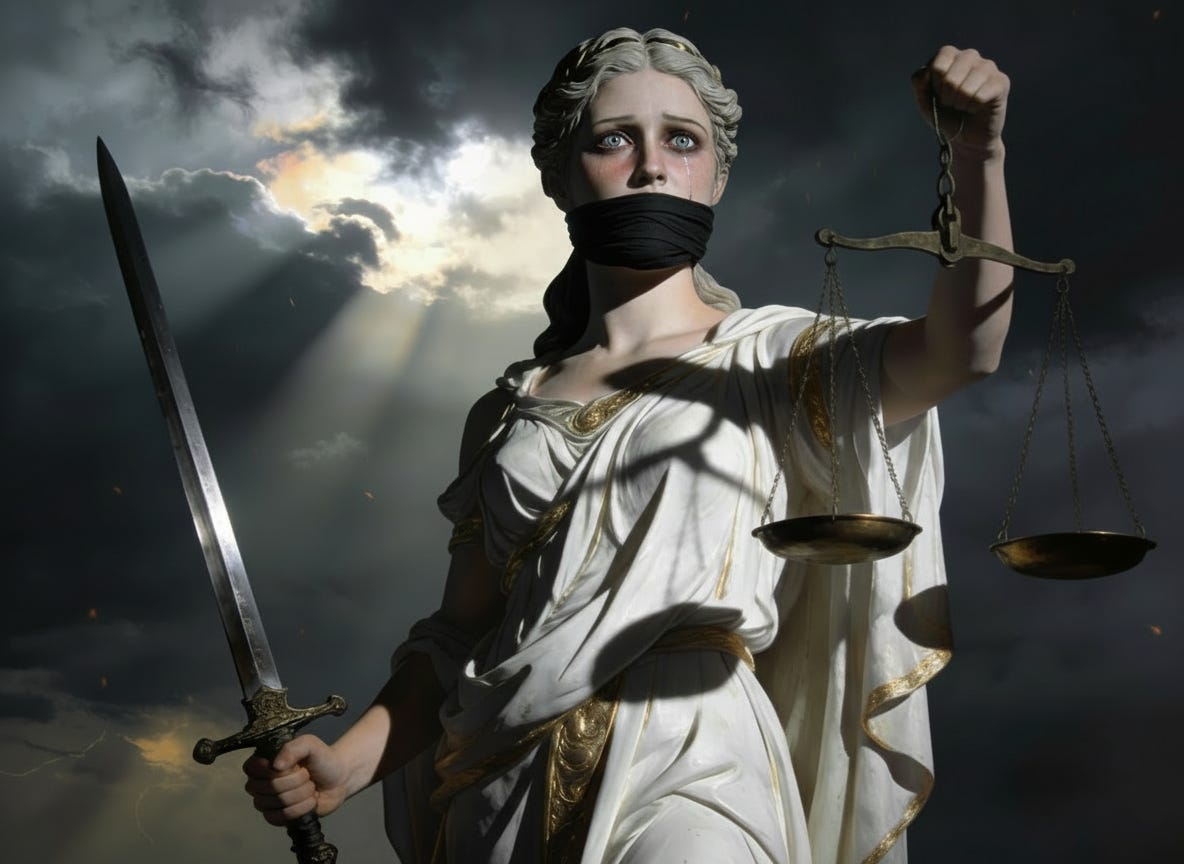
Several years ago, I was teaching a law school seminar called “Feminist Legal Theory” as an adjunct professor. I was relieved when no men signed up for the class because after teaching as an adjunct for over forty years I can say one thing with certainty: women do not talk as much when there are men in the room, even when those men “identify” as women. After a few weeks together and some good discussions, I nevertheless sensed that some of the women in my all‑female class were silencing themselves.
Part of this, I thought, was conditioned sensitivity to others in the current social climate. The mostly white women remained true to stereotype, polite and hesitant to say anything too controversial lest they offend someone. The few women of color chose their words carefully as well. Everyone went silent when I tried to initiate discussion of whether women’s sex‑based rights clash with gender ideology. I had not yet realized that the depth of indoctrination would require silence even in an all‑female class.
No one in the class identified as transgender, yet they could not abandon their silence on this topic. The aggressively advancing transgender movement had been with them in high school and college. When I was challenged to include trans‑identifying men in my definition of feminism for the class, I declined, explaining that in Feminist Legal Theory we would be discussing women.[i]
To try to break through this self‑censoring, I constructed an exercise in which each student spoke one‑on‑one with another student for ten minutes about something she had wanted to say in class but did not. Then they switched partners until each student had talked to every other student and the class was almost over. As the session ended, I sensed a palpable release among them. They reported that the exercise was a great relief and that they felt substantially more connected to each other. I did not realize I had just unified them against me.
I knew that many women had suffered censorship and job loss for speaking about gender identity. I asked my students: how had we arrived at this place where women could not discuss their own sex class? No one would talk, except sometimes to stage‑whisper, “transwomen are women.” And I would say, well then there should be no problem limiting our discussion to women if, after all, transwomen are women.
We know that women are more likely to be interrupted. A study of the United States Supreme Court found that female justices are interrupted three times more than male justices. A woman says something at a meeting and no one responds; a minute later, a man repeats what she said and everyone declares the idea brilliant. We know the words used to describe women’s speech: shrill, bossy, hysterical, bitchy, nagging, opinionated, loud, gossip, piercing, strident, grating, chatty, abrasive, argumentative, and clacky.
What we may not know is how deliberate, thorough, and effective our silencing has been. Women have been silenced since the beginning of written history. Aristotle wrote, “Silence is a woman’s glory, but this is not equally the glory of man.” Paul takes this further in the Bible:
“Women should remain silent in the churches. They are not allowed to speak, but must be in submission, as the law says. If they want to inquire about something, they should ask their own husbands at home; for it is disgraceful for a woman to speak in the church.” (1 Cor. 14:34–35)
Elsewhere he wrote:
“A woman should learn in quietness and full submission. I do not permit a woman to teach or to assume authority over a man; she must be quiet. For Adam was formed first, then Eve. And Adam was not the one deceived; it was the woman who was deceived and became a sinner. But women will be saved through childbearing—if they continue in faith, love and holiness with propriety.” (1 Tim. 2:11–15)
In the fourteenth century, The Good Wife’s Guide encouraged women to be silent, or at least to speak sparingly and wisely so as to protect their husbands’ secrets. During that period in England, there are records of two towns’ efforts to officially silence women. In one town, the court demanded that “all the women of the township control their tongues.” In another, women were instructed to restrain their tongues and not scold or curse any man.
Women’s silence even became a subject of rhetorical study. In 1560, in The Arte of Rhetorique, Thomas Wilson wrote:
“What becometh a woman best, and first of all? Silence. What second? Silence. What third? Silence. What fourth? Silence. Yea, if a man should aske me till Domes daye I would still crie silence, silence.”
William Shakespeare criticized women’s speech. In The Taming of the Shrew, Katharina has “a scolding shrewish tongue” that Petruchio attempts to manage. Fairy tales reinforced our silence. In The Little Mermaid by Hans Christian Andersen, the mermaid willingly trades her voice to the Sea Witch for a pair of legs so she may try to find and enchant the Prince. She gives up her voice, even after asking the Sea Witch a question that is still relevant: “But if you take away my voice, what is left for me?”
It should not be surprising that women silence themselves. Men did not just use words or negative stories to control women’s speech. There had been a women’s subculture in the Middle Ages, a world in which women talked freely to each other and sought the advice and aid of midwives and wise women. The witch accusations that swept through medieval Europe ended this community and terrorized women into silence. Once accused, women were tortured, tried, and publicly executed—usually burned to death—by the tens of thousands, if not hundreds of thousands. Women learned to live in fear. Of men. And of each other. Women learned not to talk.
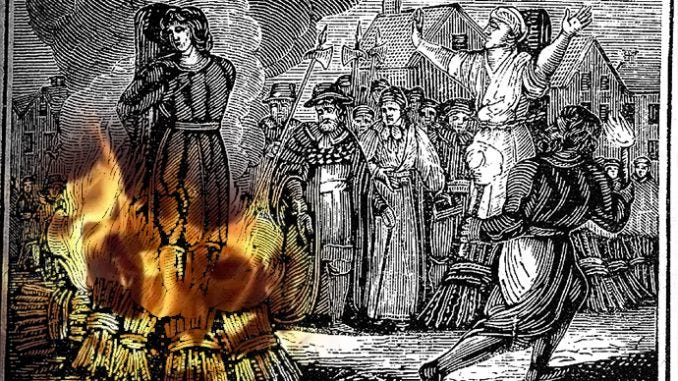
Scholars have shown that the witch trials had the effect of silencing women. They no longer brought cases to court because they feared speaking up for themselves. The number of rape accusations brought to court decreased. Women protested less. Women became more passive and submissive.
Women need not be accused of witchcraft to be silenced physically. Between the 1500s and 1800s, an iron device called a Skold’s Bridle or Brank was used to silence and humiliate women in public. This device was like a metal cage around a woman’s head, obtained from a local jailer, with a plate that went inside her mouth and pressed down on her tongue to keep her quiet. Some of the mouthpieces had a spike to ensure the woman did not attempt to speak. A husband or other male authority would walk her around the village on a chain while she wore the device. At home, a woman in the Skold’s Bridle was chained to the hearth. The Bridle was used on women considered troublesome to stop them from “gossiping.” English law defined a scold as “a troublesome angry woman who, by her brawling and wrangling among her neighbors, doth break the public peace, and beget, cherish and increase public discord.”
Quaker Dorothy Waugh has left us a rare firsthand account of such punishment. In 1655, she was taken into custody for publicly preaching in the market of Carlisle, England, where women were expected to remain silent. Waugh was bridled for three hours. She wrote:
“[T]hat which they called so was like a steele cap… which was a stone weight of Iron… & three barrs of Iron to come over my face, and a peece of it was put in my mouth, which was so unreasonable a big thing for that place as cannot be well-related, which was locked to my head, and so I stood their time with my hands bound behind me with the stone weight of Iron upon my head, and the bitt in my mouth to keep me from speaking.”
She was whipped and then run out of town while still bridled.
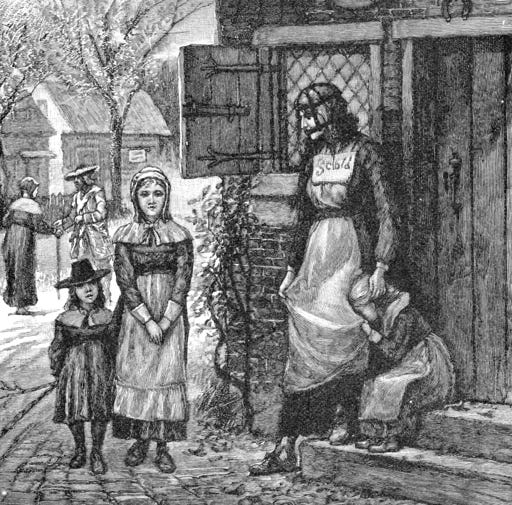
In the American colonies, women were expected to be silent. They could be harshly punished and humiliated for talking too much, speaking too publicly, or using a tone of voice that seemed grating or nagging. Women could be labeled as scolds or gossips and punished accordingly by gagging them and standing them in the market square with a sign describing their “crime.” Their tongues could be fastened shut with a cleft stick.[ii] Sometimes they were subjected to the ducking stool.[iii]
When Susan B. Anthony traveled the country giving speeches in favor of abolition and women’s suffrage, it was considered scandalous for women to speak in public. Anthony remembered women’s fight for the right to speak in public when she said, “No advanced step taken by women has been so bitterly contested as that of speaking in public. For nothing which they have attempted, not even to secure the suffrage, have they been so abused, condemned and antagonized.”
The same week I did the exercise with my class, I attended a Zoom seminar for judges conducted by a respected constitutional law scholar. His talk was on the constitutional implications for state supreme courts of the Supreme Court’s decision in Dobbs v. Jackson Women’s Health Organization. Most of the audience consisted of trial court judges, and most were men. We put our questions in the chat. As the chat rolled, the professor kept his eye on the questions and integrated them into his presentation.
The first question in the chat was from a male trial court judge and was highly specific to procedural issues unique to our state court system. He wanted to know what he should do if another state tried to charge one of its own citizens who came to Massachusetts for an abortion. A constitutional law professor could not reasonably answer a question like that; it was a procedural question involving idiosyncratic state‑by‑state rules. That was a question for the judge’s chief or for his court’s legal department. The questioner should have seen that, I thought. The professor turned the question into a more appropriate theoretical question and gave a perfectly good answer within his realm of expertise.
Toward the end of the presentation, something he said prompted me to write in the chat, “What about passing the ERA?” He saw the question, became animated, and started to answer. That was when the male moderator interrupted him: “I think there is a question that did not get answered from the beginning of the chat, about what to do if a woman from another state comes here for an abortion and her home state wants to bring her back to prosecute her.” The professor replied that he thought he had answered that already and that he did not know what a judge should do, as that was a court‑based technical question. The moderator started to wrap things up, and I started to steam. At that point, one of my closest friends, a man I have served with on two Massachusetts appellate courts for over twenty years, said, “I think Justice Cypher had a question.”
The professor re‑engaged and confirmed my fears. “You will get the same result if the ERA is passed.” That was what I had suspected, so I asked him whether it was possible that, between women losing the right to control their bodies in Dobbs and gender ideology changing the definition of women to include men, women could end up back under coverture. He said that was absolutely the logical consequence of both the right‑ and left‑wing constitutional theories operating in the legal system at the same time.
After the program, I took a minute to examine my mixed feelings. I was pleased to have his answer because I had raised this consequence before and had it dismissed as a preposterous idea. This male constitutional scholar agreed with me. But I was resentful that I needed a male authority to validate my concern. I was even more resentful that the moderator interrupted the professor just as he began to answer my question. I was grateful to my male friend for redirecting the professor back to my question. I felt angry that a man had to come to my rescue. I was disappointed in myself for not thinking quickly enough to keep my question from being derailed.
Some women like to look at the bright side and say, be thankful we have evolved. But in February 2017, during confirmation hearings for Attorney General Jeff Sessions, Senate Majority Leader Mitch McConnell attempted to silence Senator Elizabeth Warren for reading a letter from the late Coretta Scott King. This confidence that “things are better now” can itself become another way of telling women not to notice, and not to name, ongoing efforts to shut them up. McConnell defended his actions by insisting, “She was warned. She was given an explanation. Nevertheless, she persisted.”
Silencing of women continues around the world. No women are more silenced than the women of Afghanistan, who may not speak at all, and enforcement there is brutal. Women in the Western world have been silenced on the topic of sex‑based rights. Enforcement here comes as lost opportunities, friendships, jobs, and social networks. Shunning. In Canada, “wrong” speech can come with hefty fines and other punishments, so women are careful. We know this. We see this. We even hear it when a Supreme Court nominee cannot define what a woman is because she is not a biologist.
I hope that openings for such discussions have begun—little pinholes of light coming in. We must remember what a woman is and talk about it. We must draw attention to our sisters in Afghanistan, where there is no confusion about who is a woman and what that means for them. We must speak up for our sisters in Canada, who cannot risk it themselves. And we must persist in the United States. If you cannot define a woman, you cannot defend a woman.
[i] This turned out to be my own “silencing” mistake with later consequences. A subject for another Substack.
[ii] In England the cleft stick was used as a punishment tool to trap the tongues of “overtalkative” women. Records of the Town of East‑Hampton from 1639 to 1680 note that cleft sticks were used “to curb the tongues of unruly women,” including a 1652 entry ordering that “Goody Edwards shal pay 3 Lb or have her tongue in a cleft sticke for the Contempt of a warent.”
[iii] A ducking stool was mainly a device for punishing “scolds” and other allegedly disorderly women by repeatedly plunging them into water, though in some places it overlapped with witch‑persecution practices.
Thank you Elspeth. This was brilliant. Brought me back to a great Introduction to Women’s History Class I took while at UMASS Amherst 40 years ago.
In 1985 when I took that wonderful class it was the first time I had the opportunity as a woman to think about the place of women in society from a historical perspective, how it has changed, for better or worse. And it did this from the multi focus lens of both race and class. Always from the framework that there were differences but also similarities since we were all women.
1985 also marked the 10th anniversary of UMASS’s Women’s Studies Department. Thinking about where we are now versus then, I can say without question we are going in the wrong direction. A microcosm of what is happening is no less apparent than at my dear old alma mater. In 2009 they changed the name of the Department to Women, Gender, Sexuality Studies. From their website:
In 2009, after years of discussion, the Women’s Studies Program officially changed its name to Women, Gender, Sexuality Studies (WGSS). Affiliated and core faculty recognized the fact that the field had changed since the program’s founding. It had become clear that rather than a singular focus on women’s experiences and oppression, women and gender should be studied in relation to race, class, and sexuality. These categories are now conceptualized as dynamic, historically specific, and mutually constitutive, and cannot be understood in isolation from one another. To a great extent, the UMass Women’s Studies program had been teaching this integrative approach for many years and it was simply time to change the name accordingly. But, like the AQAD review, it was also an opportunity to take a close look at where the program stood and where it might go, and especially to examine the state of the curriculum and make sure that intersectionality was addressed across the board.”
This opaque gobbledegook statement doesn’t really say anything to me- other than Women’s Studies isn’t important enough to be looked at solely from a women’s perspective historically.
Elspeth! This might be your best yet! So beautifully written! Thank you!